

How to Fill a Layer Cake
In this baking tutorial post, I will share with you step by step how to fill a layer cake. I will share with you tips and tricks as well as my favorite cake supplies to help you become a cake filling master!
Tools & Supplies for Filling a Layer Cake
Here is a list of the supplies I use when filling a cake. You do not need every tool, but these are definitely my favorites that make filling and frosting a cake easy and fun!
- Cake turntable: A cake turntable helps to create a smooth buttercream finish on the top and sides of the cake.
- Nonslip mat: This helps to hold the cake board in place on the cake turntable so the cake does not slide.
- Cake board: Building the cake on a round, flat cake board helps for easy decorating. The cake board should be slightly larger than the diameter of the cake.
- Offset spatulas: Offset spatulas are used to apply frosting to the cake and spread the filling evenly.
- Cookie scoop: I use a large cookie scoop to portion buttercream in between layers to ensure the layers of frosting are even.
- Piping bag: A piping bag will help you create a border of frosting around the edges of the cake layers to hold the filling in place.
- Cake scraper: A cake scraper or bench scraper creates a smooth finish to the sides of the cake. I prefer to use a metal cake scraper, but you can also use plastic or acrylic cake scrapers as well.
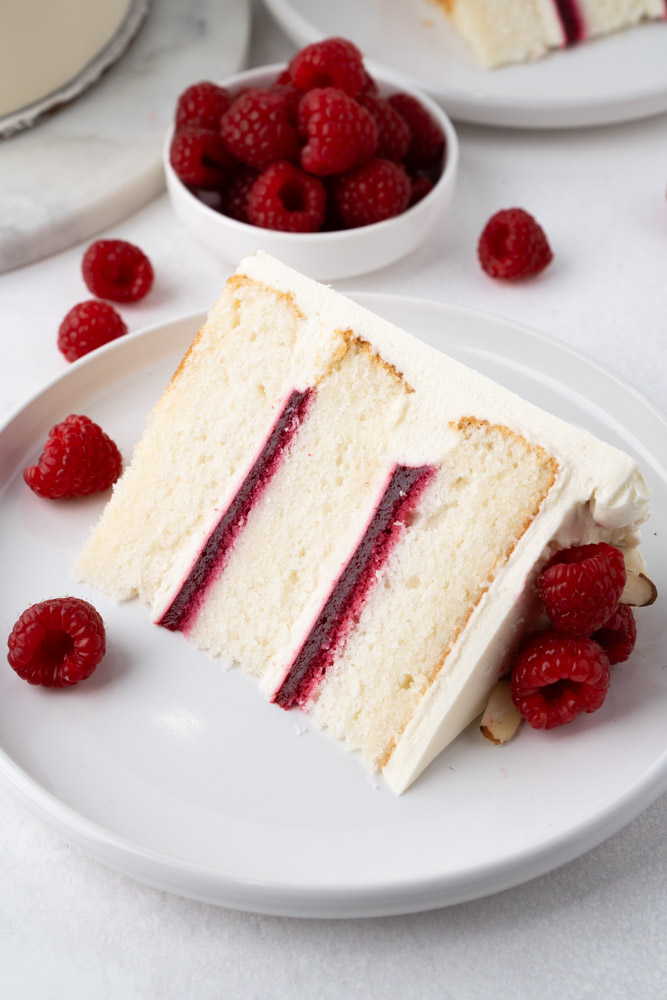
The cake pictured is my raspberry almond cake which is made with white almond cake layers, shortcut Swiss meringue buttercream frosting, and raspberry filling. Be sure to check out the recipe!
Step 1: Place the first cake layer on the cake board
Before you fill a layer cake, it is helpful to level the cake layers by removing the domes of the cake with a serrated knife to create an even, flat-topped cake.
Add a small amount of buttercream to the round cake board and spread evenly with an offset spatula. This will hold the bottom cake layer in place. Then, place your first cake layer onto the board. Be sure the cake layer is centered on the board.

Step 2: Add a thin layer of frosting onto the cake layer
Spread a thin layer of buttercream frosting onto the cake layer using an offset spatula. Use a large cookie scoop to help you portion out the frosting. Adding a thin layer of buttercream helps create a bit of a barrier between the filling and the cake so the cake doesn’t get soggy and the filling stays in place.

Step 3: Pipe a border of buttercream around the edge of the cake layer
Fill a piping bag with the tip cut off with the buttercream frosting. Pipe a thick border of frosting around the outer edge of the cake. This buttercream border prevents the filling from leaking out of the sides of the cake as you are stacking and frosting the cake, and also helps to create more structure so the cake layers don’t slide off of each other.

Step 4: Spread the filling onto the cake layer
Add your desired amount of filling into the center of the cake layer inside of the buttercream border. Do not overfill the cake or the filling can leak out of the sides of the cake or the cake layers will slide as you stack the cake. For my three layer 7-inch round cakes, I typically use about 1/2 cup of filling in between the layers. Spread the filling evenly with an offset spatula.


Step 5: Add the next cake layer
Place the next layer on top of the filled cake layer. Be sure that the second cake is centered on top of the first layer so the sides are straight and even.

Step 6: Repeat the process
Repeat the same process as mentioned above with the second cake layer. Spread a thin layer of buttercream, pipe a buttercream border, and then add the filling to the second cake layer.


Step 7: Add the final layer of cake
Add the last cake layer on top of the filling with the bottom side facing up. This ensures that the top of the cake is flat and even. Be sure that the final cake layer is centered on top of the previously cake layers.

Step 8: Chill the cake
This step is optional, but if you are new to making filled layer cakes, it’s a great was to set yourself up for success. Before you start adding a crumb coat to the cake, chill the cake in the refrigerator for about 15 minutes. This quick chill will help firm up the buttercream borders that are holding in the filling, which will make applying the crumb coat a bit easier.
Step 9: Crumb coat and chill the cake
The next step is to apply a crumb coat. A crumb coat is a thin layer of frosting that traps crumbs so the final layer of frosting is free of crumbs and smooth.
Apply and smooth the buttercream with an offset spatula. Then, use a cake scraper to smooth the buttercream on the sides. Use an offset spatula to smooth the buttercream around the top edges of the cake by pulling it gently toward the center of the cake.
After you finish the crumb coat, you will want to chill the cake in the refrigerator for about 30 minutes until the buttercream is set. This helps the buttercream firm up so when the cake is frosted, the crumb coat stays intact, keeping the crumbs trapped and the cake firmly stacked.

Step 10: Frost and decorate the cake
After the crumb coat has chilled, it is time to add the final layer of buttercream frosting! Add buttercream to the top of the cake and smooth it out using an offset spatula. Then, work your way down, applying a thick layer of buttercream to the sides of the cake.
Decorate the cake however you would like! Make the sides and top smooth or add some texture with an icing spatula or cake comb. Pipe a border of buttercream, make a drip cake with chocolate ganache, or keep things simple and rustic! Be sure to chill the cake when you are done frosting and decorating to firm everything up!

And that is it! You now know how to fill a layer cake! The process can take some practice, but in this case, the practice is DELICIOUS!

Video Tutorial
Here is a quick video tutorial on how to fill a layer cake based on the instructions above!
Frequently Asked Questions
What are some cake filling ideas?
- Lemon curd, salted caramel sauce, vanilla or chocolate custard or pastry cream, pudding, or fruit fillings (raspberry, strawberry, & blueberry), and no bake cheesecake filling make great filling options for cakes!
Does this method work with other types of frosting?
- Yes! You can use the same method with Swiss meringue buttercream, Italian meringue buttercream, cream cheese frosting, or even whipped cream frosting. Just note, cream cheese and whipped cream frosting are much softer than buttercream, so you have to work delicately and not overfill the cake.
What should I do if I don’t have a piping bag?
- No piping bag? No problem! If you have a resealable plastic bag, simply fill the bag with frosting and cut one of the corners off to use as a piping bag.
What should I do if the filling starts leaking out of the sides?
- First, take a skewer or straw and insert it into the top of the cake down to the cake board to hold the layers in place.
- Next, chill the cake immediately. If you have freezer space, chill it in the freezer until firm.
- Then, add a thick layer of frosting around the sides of the cake. This should help to seal the sides of the cake to prevent the filling from leaking more.
Filled Cake Recipes You Will Love
Now that you know how to easily fill a layer cake, try out these delicious filled cake recipes on my blog!
- Raspberry almond cake
- Chocolate raspberry cake
- Chocolate hazelnut cake
- Banana split cake
- Chocolate peanut butter cake

About Courtney
Baker | 80s Lover | Cookbook Author
Courtney is a self-taught home baker and cookbook author of “Girls Just Wanna Bake Cupcakes”. She loves to create new and unique recipes while simultaneously listening to 80s music.


Never Miss A Sweet Recipe!
Subscribe get the latest recipes, baking tips and more sent straight to your inbox!
Did you make this recipe or want to see more? Make sure to leave your review below and tag me on Instagram @CakeMeHomeTonight so I can see your creations!